Estates and paperwork
If you’re the one who handles the paperwork at home, there are 5 things your family couldn’t sort out without you
Legavia Editorial | October 2026 | 4 min read

In almost every household, one person takes care of it. They know when the insurance renews, which account each bill comes out of and which drawer the deed ended up in. Everyone else gets to relax precisely because that person is there.
That peace of mind has a catch. The day that person can’t keep up —a long hospital stay, an accident, or when they’re gone— whoever steps in doesn’t inherit a system. They inherit a jigsaw puzzle without the picture on the box.
These are the five pieces that are hardest to place.
1. What even you don’t remember you have
Try listing it all from memory. The everyday accounts come easily. The hard part is everything else: the life policy from an old employer, the 401(k) you never rolled over, the savings account you haven’t touched in years.
If they slip your mind, picture someone who doesn’t even know to look. It happens so often that state insurance regulators built a free search tool for it in 2016, and it has since matched families with more than $16 billion in life insurance and annuity benefits nobody had claimed. State treasurers estimate that about 1 in 7 Americans has unclaimed money or property waiting.
Source: National Association of Insurance Commissioners (Life Insurance Policy Locator, figures through July 2026); National Association of Unclaimed Property Administrators.

2. The list nobody is going to hand your family
It’s easy to assume that, when the time comes, someone will have it all in one place: the attorney, the bank, “the IRS.” They won’t.
There is no national registry of wills, and no office that keeps a list of what a person owns. That’s where anything centralized ends. Which banks you have accounts with, which bills are on autopay, what you owe and what you’re owed: all of that gets asked one institution at a time, and only if it occurs to someone to ask.
Your kids know where you live and probably which bank you’ve always used. The rest, only you know.
3. The deadlines that don’t wait for the paperwork to turn up
Grief needs time, and paperwork doesn’t give any. Some steps have a deadline set by law, and that date doesn’t move because the family is still looking for a policy. Every week spent tracking down documents is a week less to decide calmly.
These are the main ones. Some are actual rules and others are just good practice; it helps to tell them apart.
General information as of October 2026, not legal, tax or financial advice. Rules vary by state; confirm current instructions before you act.
4. What’s spread between a drawer, a folder and your phone
The deed in the living-room cabinet. The policies in a folder. The bills in your email, the bank in an app and the contracts in a PDF that arrived years ago. To you, it’s a system. To anyone else it’s twenty places, and half of them can’t be seen.
Most states have adopted a law that lets an executor ask online services for a list of a person’s accounts and messages, and for the content itself only if the owner agreed to it while alive. But that right is of little use if no one knows the account exists.
You don’t have to move everything to one spot. What’s needed is an index: one page that says what there is and where it is.
Source: Uniform Law Commission, Revised Uniform Fiduciary Access to Digital Assets Act (as adopted by each state).
5. The conversation that never finds its day
Your kids don’t ask because they don’t want to seem interested in the money. You don’t bring it up because you don’t want to worry them. And so the years go by, with both sides sure a better moment will come.
That’s why many people find it easier to write it down than to say it. No family meeting, no talk of illness or inheritance: you fill in one page on a Sunday, another the week after, and one day all it takes is “if you ever need it, it’s in this folder.”
It’s the same conversation, already had.
Take the test
Would your family know?
Choose “Yes” only if someone at home could answer today without asking you.
-
Would your family know whether you have a will, and where the original is?
-
Would they know which banks you have accounts with?
-
Would they know if you have life insurance, and with which company?
-
Would they know who to call first?
-
Would they know which bills are on autopay and which subscriptions you pay for?
-
Would they know where the deed to the house and the car title are?
-
Would they know how to find what only exists on your phone or in your email?Online banking, paperless statements, contracts sent by email.
-
Would they know about retirement accounts or pensions from past jobs?
Answer them all to see your result.
You’re in very good shape
All that’s left is to put it in writing in one place, so it doesn’t depend on anyone’s memory.
There are important gaps
Your family would know where to start, but they’d have to piece several things together on their own.
Right now, nearly everything depends on you
That’s not unusual when one person handles the paperwork. It’s fixable, and you can start today.
Your answers stay on this device. Nothing is saved or sent.
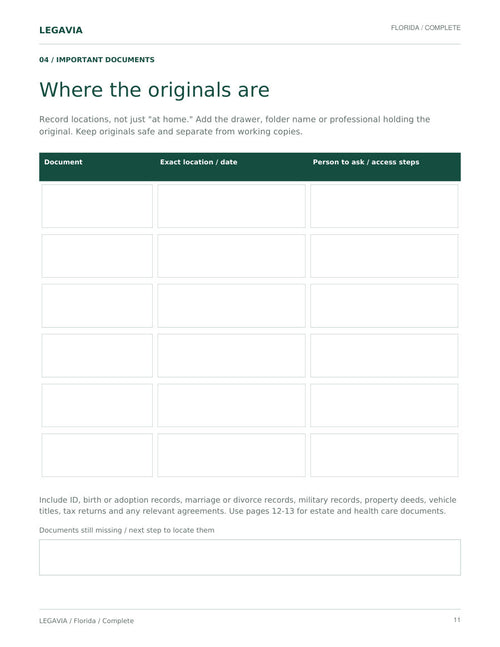
From Legavia
The Legavia organizer: your map, as a fillable PDF
The page shown in this article is one of 18 to 53+, depending on the plan.
- Pages for people, documents, accounts and your home
- First steps for your family, with a section for your state
- Fill on screen or print
- Not a will and not a substitute for advice — an organizing tool
30 days to try it